Wall Mount Electrical Enclosure: Logic vs. Catalog Hype
A gasket that peels after eighteen months of washdown cycles doesn’t just fail on its own. It takes a VFD or a PLC rack down with it, and the resulting NEMA audit finding lands on someone’s desk with a dollar figure attached.
This wall-mount electrical enclosure guide is created to help engineers and procurement managers who have already been through that phone call and don’t want a second one. No catalog copy, no filler. Just the material logic, the layout tradeoffs, and the manufacturing tolerances that separate a box that survives ten years from one that doesn’t make it through a single wet winter.
Executive Summary (TL;DR): Wall Mount Electrical Enclosure Selection Guide
Choosing an industrial enclosure requires balancing strict environmental protection with operational layouts. This blueprint bypasses catalog hype to deliver an engineering framework for specifying the right cabinet without overpaying or risking field failures.
Key Takeaways
- Material Logic:Match your exact environment to avoid over-engineering. Use 304/316 Stainless Steel for marine/chemical environments, Galvanized Steel for high-moisture outdoors, and Carbon Steel for standard, high-impact factory floors.
- Footprint & Access:Optimize your layout space. Select a Single Door unit for tight horizontal spaces, or a Double Door configuration to cut front swing clearance in half while maximizing tool access.
- Thermal Management:Avoid overcrowding internal switchgear. Always calculate the cumulative heat dissipation before sizing to prevent localized heat traps and component burnout.
- Factory Precision vs. Field Fixes:Eliminate structural warping and leaking. Rely on 4000W laser cutting (+/- 0.05 mm accuracy) for custom conduit entries and automated continuous foam gaskets over hand-glued alternatives.
Wall Mount Electrical Enclosure: Stainless vs. Carbon Steel
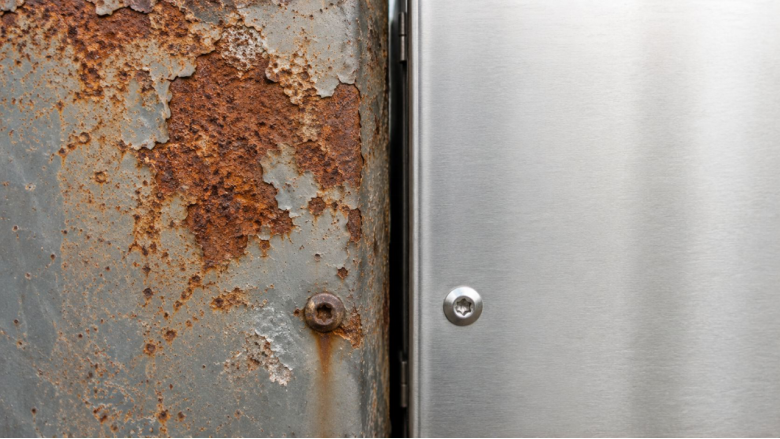
Every material choice on this list solves a specific failure mode. Get the match wrong, and you’re either paying for corrosion resistance you don’t need or watching a cheaper box rust through its seams in a facility that never needed stainless in the first place.
When Salt Spray Is Eating Your Enclosure Alive
Salt spray and chemical washdown quickly eat away at carbon steel, sometimes within a single maintenance cycle in a marine or food-processing environment. 304 and 316 stainless steel resist that pitting because the chromium content forms a passive oxide layer that carbon steel simply doesn’t have. 316 adds molybdenum for better resistance to chlorides, which matters if the enclosure sits near a coastal facility or a chemical washdown bay.
When It’s Just Humidity, Not a Chemical Bath
Persistent humidity without direct chemical exposure is a different problem, and it doesn’t require the stainless price tag. A galvanized steel enclosure features a zinc coating that sacrifices itself to protect the base metal, helping it resist rust in outdoor utility applications at a fraction of the material cost.
When the Real Threat Is a Forklift, Not Corrosion
Standard indoor production lines deal with airborne oil mist, metal shavings, and general dust rather than corrosive exposure. Carbon steel enclosures hold up well there, and the sheet’s impact resistance actually outperforms stainless in situations where something might get dropped on the box or bumped by a forklift.
Environment | Failure Mode | Correct Material |
Marine & heavy washdown bays | Salt-spray pitting, chemical degradation | 304 / 316 stainless steel |
High-moisture outdoor utility | Rust and structural breakdown from humidity | Galvanized steel |
Standard factory floors | Oil mist, shavings, dust, impact | Carbon steel |
Space Constraints? Choosing a Single Door Wall Mount Enclosure vs. Double Door
Door configuration determines how the enclosure fits within an actual floor plan, and this is where many orders go wrong.
Single Door: Simple, but It Needs Room to Swing
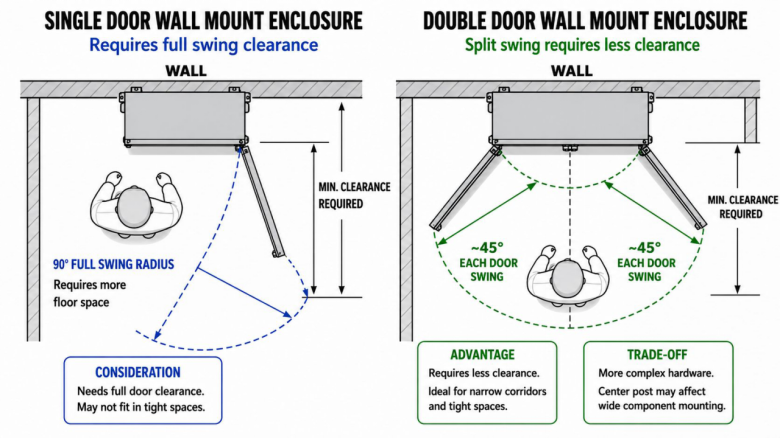
A single-door wall-mount enclosure is the standard configuration for narrower wall runs, but it requires a full swing radius to open completely. If a technician has to pull a full 90-degree swing in a tight electrical room, that clearance requirement can eliminate an otherwise ideal mounting location.
Double Door: Built for Corridors That Won’t Give You an Inch
Double-door configurations solve that specific problem with wide back panels. Each door needs only half the swing clearance of a single door because the opening splits between two panels. That makes the double door layout the better fit for narrow corridors or walkways where full component access still matters but floor space doesn’t allow for a wide swing arc.
The trade-off is a slightly more complex hinge-and-latch setup and, on some models, a center post that can interfere with wide-component mounting. Neither configuration is universally correct. It comes down to measuring the actual swing path before finalizing dimensions, not after the box arrives.
The Silent Component Killer: Thermal Overcrowding in Your Wall Mount Enclosure
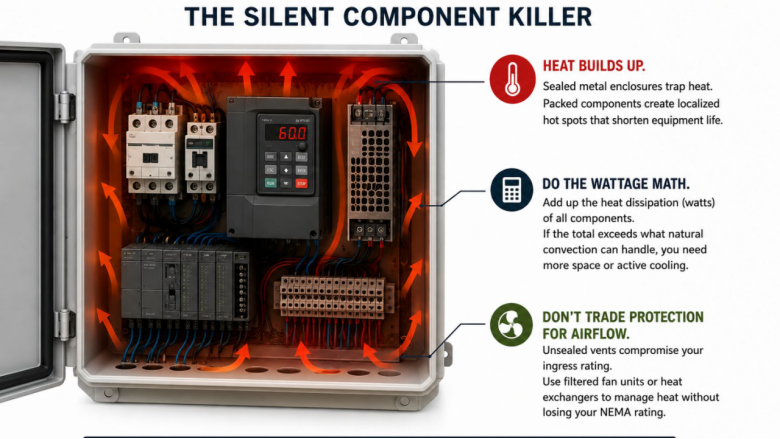
The Heat You Don’t See Coming
A sealed metal box holds heat. That’s obvious once you say it, but it’s the detail most people skip when they’re specifying dimensions from a parts list rather than a thermal calculation. Packing switchgear, transformers, and drives too tightly into a fixed-volume enclosure creates localized heat pockets that don’t show up on a spec sheet, only on a thermal camera after the components have already started degrading.
Doing the Wattage Math Before You Cut Steel
Calculate the cumulative heat dissipation for each component entering the box before locking in the cabinet dimensions. Contactors, VFDs, and PLCs each carry a wattage rating for heat output, and those numbers add up faster than most layouts account for. If the total exceeds what natural convection can handle through the enclosure’s surface area, you’re looking at either more internal volume or active ventilation.
Don’t Trade Your Ingress Rating for Airflow
Adding fans or vents introduces a new problem. It can compromise the ingress rating you specified the enclosure for in the first place. A NEMA 4X box with an unsealed vent cut into it isn’t NEMA 4X anymore. Filtered fan units and heat exchangers are designed specifically to address this without compromising the seal rating, but they need to be planned into the initial design, not added as a field fix after the first thermal shutdown.
Custom Industrial Electrical Enclosure from xyzsteel.com Eliminates Field Modification Risks
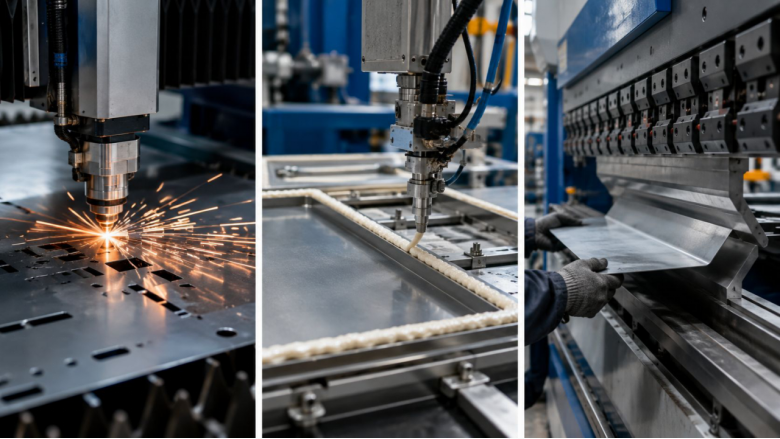
Most of the failures above trace back to a box that was close enough on paper but wrong in the field. At xyzsteel.com, we close that gap in the factory, and the difference shows up in our tolerances rather than in marketing language.
No More Hand-Filed Conduit Entries
Conduit entries cut on-site with a hand drill or hole saw introduce burrs, rough edges, and occasionally structural warping around the cutout, all of which compromise the seal the enclosure was rated for. We cut entries directly from your CAD files on a 4000W laser system, maintaining a tolerance of +/- 0.05 mm, so the cutout matches your fitting the first time, rather than being hand-filed into submission on the shop floor.
The Gasket Seam That Never Gets a Chance to Peel
Gaskets fail at the seams more often than they fail across the flat surface, and a hand-glued strip gasket is where most of those seam failures start. Our factory runs a continuous, automated foaming process that applies a seamless polyurethane gasket around the full door perimeter, with no joints for water or dust to work into over repeated washdown cycles.
A Chassis That Won’t Sag Under a Transformer
Structural sag under the weight of a transformer or a heavy backpanel is a slow failure. It doesn’t happen on day one; it shows up eighteen months in, when the door alignment starts drifting, and the gasket compression becomes uneven. Whether you order a carbon steel enclosure or a marine-grade 304/316 stainless steel model, our sheets undergo precision multi-angle bending to within +/- 0.5 mm and come with heavy-duty external mounting tabs to keep the chassis square under sustained load.
When the Deadline Won’t Move
For projects on a deadline, we offer a 7-day turnaround on custom enclosure samples, backed by 24/7 engineering support, so your design can be validated in the field before you commit to a full production run.
The 60-Second Pre-Order Checklist for Custom Wall Mount Enclosures
Run through this before submitting a purchase order. Every item here has caused a return or a field modification on a real project at some point.
- Static load capacity:has the wall or structural framing been verified to support the combined weight of the enclosure and all internal components, not just the empty box?
- Conduit entry planning:are entry points mapped for clean cable routing, or have pre-punched entries been coordinated with the fabricator ahead of delivery?
- Security and locking:does the site need a simple quarter-turn latch, or does it call for a 3-point pad-lockable handle for tamper resistance?
- Access clearances:since wall-mounted units can’t be accessed from the rear, is there enough front-swing clearance for full door deployment once the unit is installed?
Stop Guessing on Specs
xyzsteel.com doesn’t work off a catalog. We start with your requirements, your wall dimensions, your component list, your environment, and build the enclosure around what your project actually needs, whether that’s a standard NEMA-rated single door wall mount enclosure, a double door unit for a tight corridor, or a custom galvanized steel build for an outdoor utility run.
Send your CAD drawings or just tell us your requirements. We’re ready to help you get to a custom solution. Request an instant quote and our engineering team will explain all the solutions and options for your business.
Frequently Asked Questions
1. What is the difference between NEMA 4 and NEMA 4X enclosures?
NEMA 4 and NEMA 4X both protect against dust, rain, and hose-directed water, and the test standards are identical. The X rating adds a corrosion-resistance requirement, which is why NEMA 4X enclosures are typically built from stainless steel or fiberglass rather than painted carbon steel. If the install site involves washdown chemicals or salt exposure, NEMA 4X is the one to spec.
2. Can a wall mount enclosure be installed outdoors?
Yes, provided the ingress rating matches the exposure. NEMA 3R covers rain and outdoor use but not washdown or corrosion, while NEMA 4 or 4X handles hose-directed water and, in the case of 4X, ongoing corrosive exposure. Sun load also matters outdoors, since a sealed metal box in direct sunlight can run hotter inside than the ambient temperature outside.
3. What size wall mount enclosure do I need?
Size depends on the internal component footprint plus clearance for heat dissipation, wiring bend radius, and any DIN rail or backpanel hardware. A box sized to just fit the components with no airflow margin will run hot under load. Most fabricators will size based on a full parts list and a total heat dissipation rather than the enclosure dimensions alone.
4. What is the difference between a wall-mounted and a floor-mounted enclosure?
Wall-mounted enclosures attach directly to a wall or structural surface and typically support lighter component loads, usually under a few hundred pounds, depending on the mounting hardware. Floor-mount and freestanding enclosures sit on their own base and support heavier switchgear, larger backpanels, and higher component density where wall load limits would be a problem.
5. How do you calculate ventilation needs for an electrical enclosure?
Add up the wattage output of every internal component to get the total heat load, then compare it against the enclosure’s surface area and the temperature differential between the inside and outside air. If natural convection through the sheet metal can’t keep pace, the options are a larger enclosure, a filtered fan, or a sealed heat exchanger that adds cooling without breaking the ingress rating.