IP66 Waterproof Junction Box Buying Guide: Size, Material, and Installation Tips
An IP66 waterproof junction box prevents water and dust out of electrical systems exposed to rain, washdown, or dusty industrial sites. A single rainstorm can short-circuit outdoor wiring, halting production lines or damaging expensive equipment. In industrial washdown areas, high-pressure jets force moisture into poorly sealed enclosures, corroding terminals and creating fire hazards.
IP66 is the industry-standard specification for protection against powerful water jets and complete dust ingress, defined by IEC 60529. This rating confirms your junction box survives harsh outdoor conditions, factory washdown cycles, and dusty environments without failure.
Executive Summary (TL;DR)
The Core Problem: Water and dust entering through poorly designed junction boxes cause electrical short circuits, fire hazards, and equipment damage in harsh outdoor or industrial environments.
The “Sweet Spot” Solution: An IP66-rated junction box (defined by IEC 60529) is the optimal industry standard. It confirms complete protection against dust (first digit 6) and powerful water jets from any direction (second digit 6, tested at 100 liters/minute).
Key Selection Factors
Factor | Critical Takeaway |
Environment | Industrial waterproof junction boxes need resistance to chemical washdowns, vibration, and dust. Outdoor junction boxes prioritize UV stability, sealed cable entry points, and wide temperature tolerance. |
Sizing | Choose an internal volume that accommodates conductors with reserved space. Apply NEC Article 314 guidance: Minimum Volume = (Cable Area×Quantity)×Space Factor, where the Space Factor is 1.2 to 1.5. |
Material | ABS: Budget-friendly, lightweight, lacks UV stability (indoor use). Polycarbonate (PC): High impact resistance, UV-stable, durable in harsh weather. Metals (Steel/Stainless/Aluminum): Suited for marine or heavy industrial workloads with EMI shielding and heat dissipation. |
Design Features | IP66 junction box performance depends on gasket groove geometry, pre-molded knockout patterns, wall thickness, and mounting boss reinforcement. |
Scenario Differences: Outdoor vs. Industrial Junction Boxes
Industrial Sites
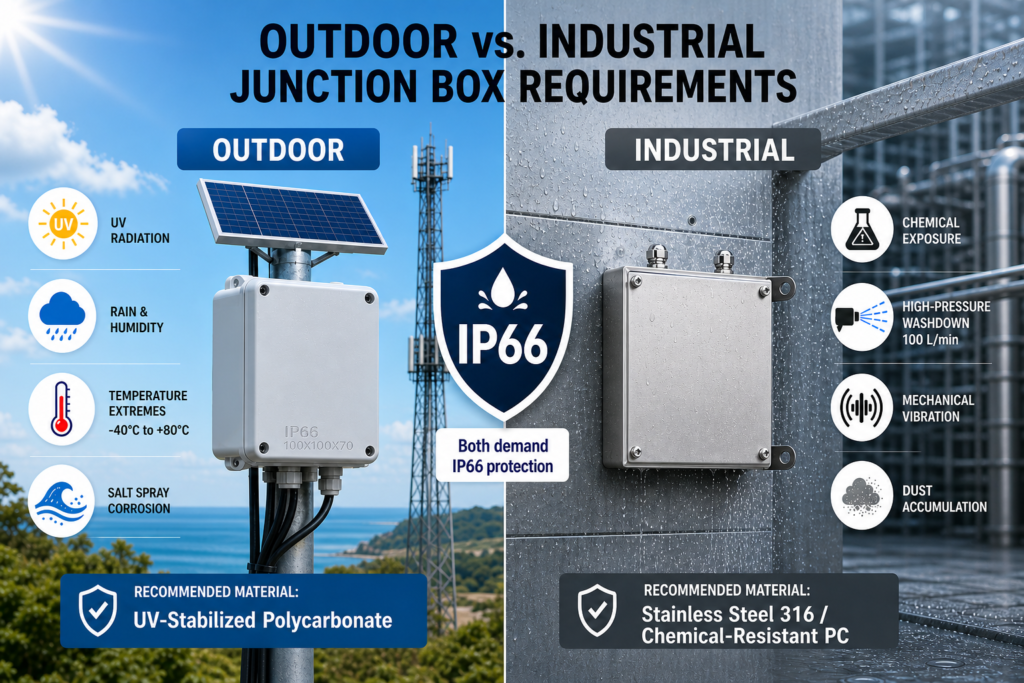
Factories, chemical plants, and food processing facilities demand a waterproof junction box that withstands aggressive cleaning protocols. High-pressure washdown cycles blast water at 100 liters per minute, testing every sealing surface on the enclosure. Chemical vapors attack plastic housings, while vibration from heavy machinery stresses mounting points over time.
Stainless steel or chemical-resistant polycarbonate junction boxes handle these conditions. Metal enclosures provide better vibration resistance and grounding paths for sensitive electronics. Polycarbonate offers chemical resistance while remaining light enough for ceiling-mounted installations.
Outdoor Environments
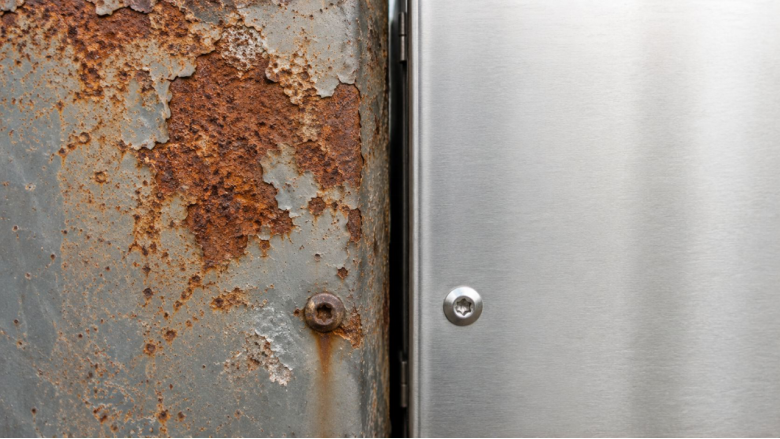
Solar farms, telecom towers, and marine docks face different stresses. Direct sunlight degrades plastic enclosures through UV exposure. Temperature swings from freezing nights to hot days strain sealing surfaces and promote internal condensation. Salt spray corrodes metal housings in coastal installations.
UV-stabilized polycarbonate junction box housings resist sun damage for 10+ years. Stainless steel handles salt spray without surface corrosion. Enclosures with deep gasket grooves and reinforced cable entry bosses prevent water wicking into the interior.
Environmental Parameter | Industrial | Outdoor |
Primary threat | Chemical exposure, vibration | UV degradation, temperature cycling |
Water exposure type | High-pressure jets (washdown) | Rain, humidity, condensation |
Dust level | Heavy (grinding, cutting) | Moderate (wind-blown) |
Temperature range | +5°C to +60°C (controlled) | -40°C to +80°C (uncontrolled) |
Junction box recommendation | Stainless steel, chemical-resistant PC | UV-stabilized PC, marine-grade stainless |
Fault Case Analysis
A chemical processing plant installed ABS junction boxes near solvent storage tanks. Within six months, micro-cracks appeared in the housing from continuous vapor exposure. Moisture penetrated the cracks during washdown, causing a ground fault that tripped production for eight hours. Replacement with stainless steel enclosures eliminated the failure mode.
Select Junction Box with Logic
IP Classification: Understanding IP66
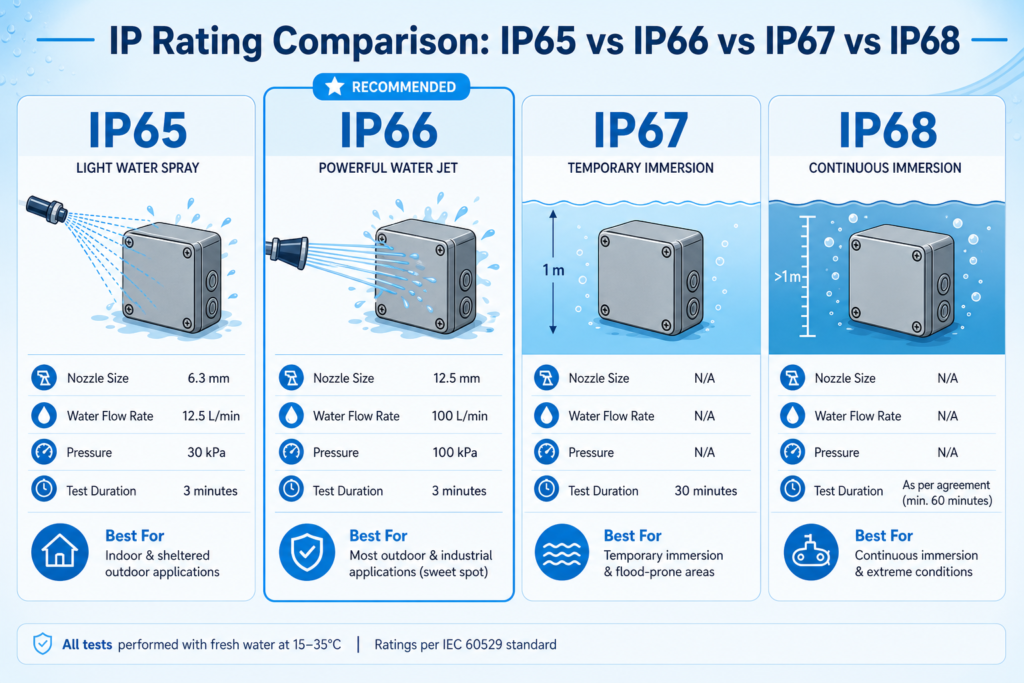
IP stands for Ingress Protection, a standardized rating system defined by IEC 60529. This international standard measures how well an enclosure prevents the ingress of solid objects and liquids.
The rating uses two digits:
- First digit: Dust protection, ranging from 0 (no protection) to 6 (complete dust-tight seal).
- Second digit: Water protection, ranging from 0 (no protection) to 9K (high-pressure, high-temperature water jets).
Higher numbers indicate stronger junction box protection.
IP Rating | Dust Protection | Water Protection | Best Application |
IP65 | Dust-tight | Water jets from a 6.3mm nozzle | Indoor industrial, light outdoor use |
IP66 | Dust-tight | Powerful water jets from a 12.5mm nozzle | Outdoor electrical, industrial washdown areas |
IP67 | Dust-tight | Temporary immersion up to 1 meter | Ground-level outdoor, flood-prone areas |
IP68 | Dust-tight | Continuous immersion beyond 1 meter | Submersible applications, marine environments |
Sizing the Junction Box for Safe Wire Management
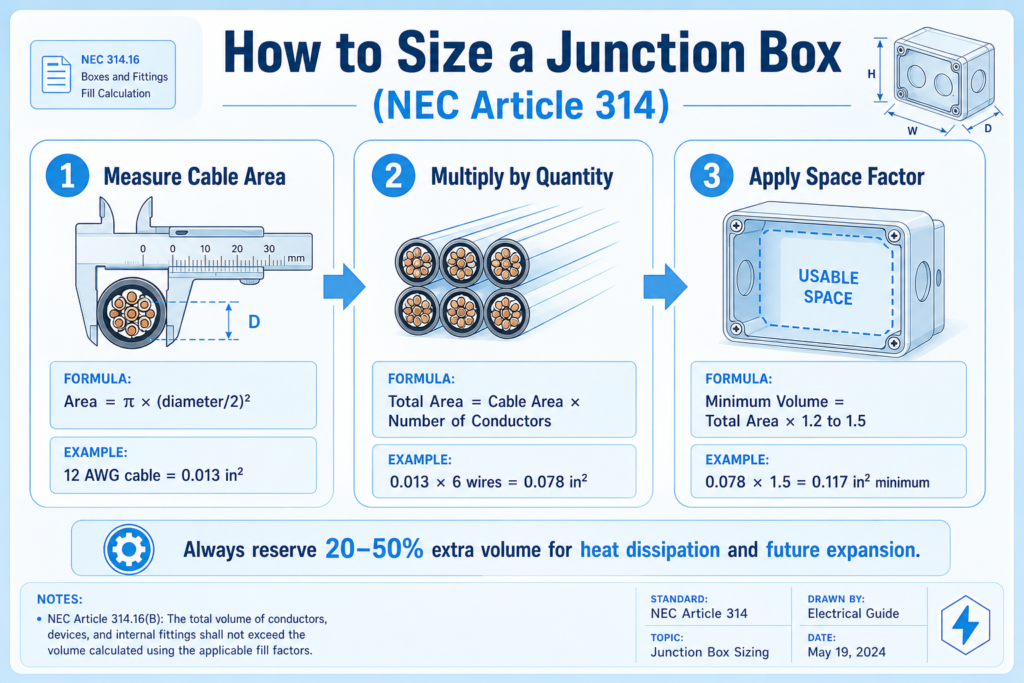
Choosing the right junction box dimensions prevents overheating, simplifies maintenance, and allows for future circuit additions. Undersized enclosures force conductors into tight bends that damage insulation. Overcrowded junction boxes restrict airflow, accelerating thermal degradation of wire insulation and terminal connections.
Minimum Volume Formula
Minimum Volume = (Cable Area × Quantity) × Reserved Space Factor
The Reserved Space Factor ranges from 1.2 to 1.5 per NEC Article 314.
- Use 1.2 for simple pass-through junction boxes.
- Use 1.5 for enclosures housing multiple devices or complex wiring.
Calculate cable area using the conductor’s cross-sectional area in square millimeters. A 14 AWG conductor has a cross-sectional area of approximately 2.08 mm2. For six 14 AWG conductors:
(2.08 mm2 x 6) x 1.5 = 18.72 mm2 of conductor area requiring proportional enclosure volume
|
 WARNING: A junction box with insufficient internal volume restricts airflow and accelerates insulation breakdown. Apply the reserved space factor when selecting enclosure dimensions. An overfilled junction box is a fire risk.
Junction Box Selection SOP
- Measure cable cross-sections.Use manufacturer specifications or wire gauge tables to determine the cross-sectional area of each conductor entering the junction box.
- Count conductors.Include current-carrying conductors, grounding conductors, and equipment bonding jumpers. Each device (switch, receptacle) counts as two conductors.
- Apply the formula. Multiply the total cable area by the reserved space factor (1.2 for simple installations, 1.5 for complex wiring).
- Add a buffer.Round up to the next standard junction box size. If your calculation shows 85 cm³, choose a 100 cm³ enclosure to allow for future modifications.
- Match to standard dimensions.Compare your calculated volume to manufacturer specifications. Select the next larger size when your result falls between two standard options.
Material Comparison: ABS vs Polycarbonate vs Metal Junction Boxes
ABS (Acrylonitrile Butadiene Styrene)
ABS junction boxes offer the lowest cost for indoor applications with minimal environmental stress. This thermoplastic resists impact at room temperature and provides adequate protection in climate-controlled spaces. ABS molds easily, allowing manufacturers to produce complex shapes with integrated mounting features and knockout patterns.
Limitations become serious outdoors:
- UV radiation breaks polymer chains, causing surface chalking and brittleness within 18 to 24 months of direct sun exposure.
- Chemical solvents penetrate ABS, creating micro-cracks that compromise the junction box IP rating.
- The material softens above 80°C, making it a poor fit for hot climates or heat-generating equipment.
The chemical plant failure described earlier illustrates ABS vulnerability. Solvent vapors attacked the polymer matrix, creating hairline cracks invisible during routine inspection. High-pressure washdown forced water through these defects.
Polycarbonate (PC)
Polycarbonate junction boxes deliver strong impact resistance and UV stability for outdoor installations. The material withstands hammer blows without cracking, suiting it for vandal-prone locations or areas with falling debris. UV stabilizers protect the polymer for 10+ years of direct sunlight exposure.
Key properties:
- Maintains mechanical strength from -40°C to +120°C.
- Resists most industrial chemicals (though strong bases and some solvents can cause stress cracking).
- Costs 40-60% more than ABS while eliminating premature replacement in harsh environments.
Trade-offs: Polycarbonate scratches more easily than ABS, which affects appearance. The enclosure can warp in sustained temperatures above 110°C. Some formulations slightly yellow over time with UV exposure, though this does not reduce impact strength or sealing performance.
Metal (Steel and Stainless Steel)
Steel junction boxes provide high mechanical protection and EMI shielding for sensitive electronics. Powder-coated carbon steel handles vibration, impact, and mounting loads that would crack plastic enclosures. The material effectively grounds electrical systems, reducing shock hazards and electromagnetic interference.
Stainless steel (316 grade) resists corrosion in marine and chemical environments. The chromium oxide layer self-heals when scratched, maintaining protection for decades. Stainless costs 3 to 4 times more than carbon steel while resisting rust in salt spray, acid fumes, or high-humidity conditions.
Metal junction boxes also conduct heat away from internal terminals, reducing thermal stress on connections. This matters in high-current applications where plastic enclosures trap heat. Metal offers better fire resistance than thermoplastics.
Material | Impact Resistance | UV Resistance | Temp Range | Best Application |
ABS | Moderate (room temp) | Poor (degrades in 18 to 24 months) | -20°C to +80°C | Indoor, climate-controlled, cost-sensitive |
Polycarbonate (PC) | Excellent (10x ABS) | Excellent (10+ years) | -40°C to +120°C | Outdoor, high-impact areas, UV exposure |
Carbon Steel | Excellent | Coating-dependent | -40°C to +150°C | Industrial vibration, EMI shielding, fire zones |
Stainless Steel (316) | Excellent | No degradation | -40°C to +200°C | Marine, chemical plants, corrosive environments |
Junction Box Design Features That Enable Waterproof Performance
The IP66 rating of a waterproof junction box depends on how its housing, gasket interfaces, and cable entry points are engineered. The following design elements determine whether the enclosure maintains its rating in real-world conditions.
Gasket Groove and Sealing Surface Design
The gasket groove on the junction box lid or body holds the seal in place under compression. A well-designed groove keeps the gasket aligned during cover removal and reseats it consistently after maintenance. Enclosures with shallow or uneven grooves allow gaskets to shift, breaking the IP66 seal.
Quality junction boxes come supplied with EPDM or silicone gaskets matched to the housing’s temperature range:
- EPDM gaskets maintain elasticity from -40°C to +120°C and resist UV, ozone, and weathering. EPDM maintains steady sealing pressure across temperature cycles, making it the standard for general outdoor junction boxes.
- Silicone gaskets extend the range to -60°C to +200°C and resist most chemicals. Enclosures designed for high-temperature or petroleum-contact applications ship with silicone seals.
Cable Entry Knockouts and Pre-Molded Bosses
A junction box designed for IP66 service includes pre-molded cable entry bosses or knockout patterns engineered for matched gland sizes. These features keep wall thickness uniform around the entry point, allowing the gland to compress against a flat sealing surface without distorting the housing.
Look for enclosures with:
- Reinforced entry bosses that resist deformation under gland torque.
- Standardized knockout sizes matching common metric or PG thread patterns.
- Smooth internal surfaces around entries to eliminate burrs that cut gaskets.
Wall Thickness and Reinforcement Ribs
Wall thickness affects both impact resistance and dimensional stability under temperature swings. Thin walls flex under washdown pressure, breaking the gasket seal momentarily and allowing water entry. Reinforcement ribs on the inside of the junction box add stiffness without raising material cost.
Polycarbonate junction boxes rated for IP66 service typically have a wall thickness of 3 to 4 mm with internal ribbing on larger enclosures.
Mounting Bosses and Hinge Design
Mounting bosses molded into the junction box exterior keep mounting fasteners outside the sealed area. Some designs route mounting holes through the back wall using internal sleeves, isolating fasteners from the enclosure interior.
For hinged enclosures, hinge geometry determines whether the gasket compresses evenly along the full perimeter when the cover closes. Quality designs use captive hinges that align the cover to the body without operator adjustment.
Customization Options
Standard junction boxes cover most installations, while custom enclosures optimize performance in specialized environments. JUTFbox offers customization across dimensions, mounting configurations, cable entry locations, and material selection. You can specify exact knockout patterns matched to your equipment, removing the need for field drilling that compromises the IP rating.
Custom junction box options include:
- Non-standard dimensions to fit tight spaces or accommodate oversized terminal blocks.
- Pre-molded mounting bosses for DIN rails, terminal blocks, or bus bars.
- Custom cable entry patterns matched to your conduit layout.
- Integrated mounting brackets for pole, wall, or equipment mounting.
- Logo molding and labeling for asset management and brand consistency.
- Specialized materials like fiberglass-reinforced polyester for chemical resistance.
Common Problem: Field modifications to a standard junction box break the IP rating. Drilling extra cable holes destroys the dust seal. Oversized openings prevent proper gasket compression around the entry.
Solution: Specify a custom junction box with factory-molded cable entries and matched gasket configurations. JUTFbox engineers design knockout layouts that preserve IP66 protection while accommodating your exact cable count and arrangement.
Wrapping Up
Selecting the right IP66 waterproof junction box protects your electrical investment and prevents costly failures. Match enclosure materials to environmental threats:
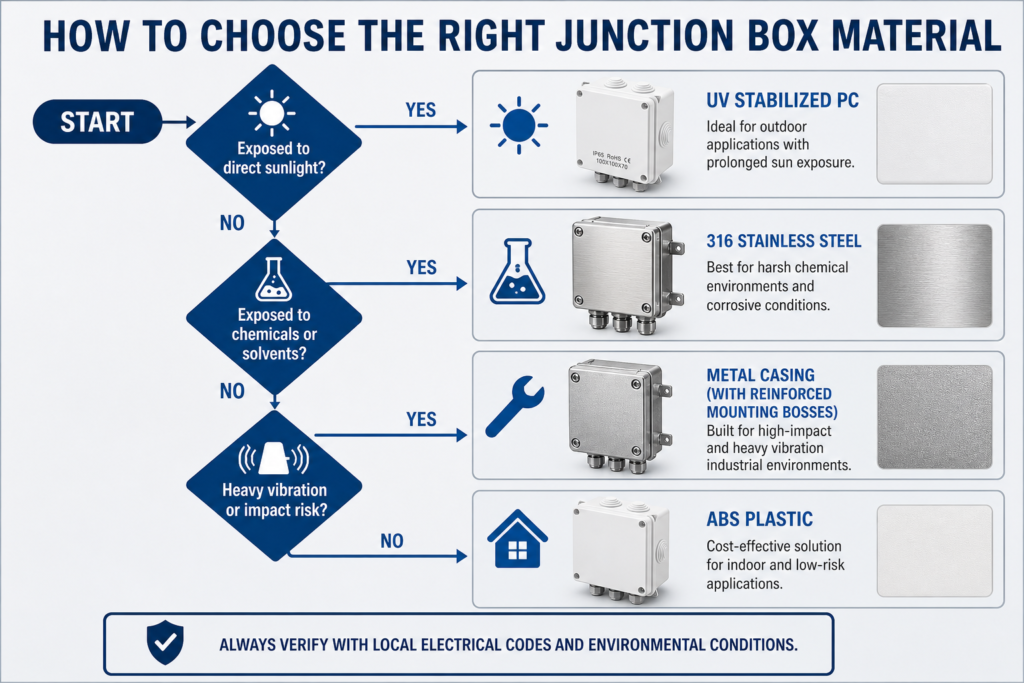
- UV-stabilized polycarbonate for outdoor sun exposure
- Stainless steel for chemical or marine environments
- Powder-coated steel for industrial vibration and EMI shielding
Calculate junction box volume using NEC Article 314 guidance with a 1.2 to 1.5 reserved space factor. This prevents overfilling, which causes overheating and code violations. Choose enclosures supplied with EPDM or silicone gaskets that suit your temperature range, and verify the housing has reinforced cable entry bosses sized for your conductor count.
For applications needing non-standard dimensions, specialized cable entry patterns, or integrated mounting features, explore JUTFbox’s customization capabilities. Factory-prepared junction boxes preserve IP ratings while reducing installation time.
Ready to specify your project? Request a quote for custom waterproof junction boxes.
FAQs
Can I use a plastic junction box outdoors?
Yes, you can when you select UV-stabilized polycarbonate with an IP66 or higher rating. Standard ABS junction boxes degrade under direct sunlight within 18 to 24 months. Polycarbonate junction boxes resist UV radiation for 10+ years while maintaining impact strength and sealing performance across temperature extremes.
Does JUTFbox offer custom waterproof junction boxes?
Yes, JUTFbox customizes junction box dimensions, materials, cable entry knockout patterns, mounting configurations, and integrated molded features. You can specify logo molding, custom colors, and specialized packaging. Factory customization preserves IP ratings and certifications while optimizing the junction box for your application.
How often should I inspect the junction box seals?
Inspect gaskets and gasket grooves annually in standard environments. Increase to quarterly in high-vibration, chemical-exposure, or extreme-temperature applications. Look for gasket compression set, surface cracks, or hardening. Replace damaged seals to maintain the waterproof rating of the junction box.
Can I drill extra holes in my junction box after purchase?
Drilling compromises the IP rating and voids most certifications. Specify a custom junction box with factory-molded cable entries to maintain protection levels. Where field modifications cannot be avoided, use properly sized cable glands rated for the enclosure’s IP level.
Why did my ABS junction box crack after six months outdoors?
UV radiation breaks down ABS polymer chains, causing brittleness and surface chalking. Temperature cycling speeds the process. ABS junction boxes are suitable for indoor, climate-controlled environments. Replace failed ABS housings with UV-stabilized polycarbonate rated for outdoor service.
How do I prevent condensation inside a sealed junction box?
Mount the junction box with a slight downward tilt so any internal moisture drains away from cable entries. Choose enclosures designed with breather vent ports that accept hydrophobic membranes, allowing air exchange while blocking water. Insulate enclosures in extreme climates to reduce internal temperature differentials.
Is IP66 enough for a solar installation?
For most rooftop and ground-mount solar arrays, an IP66 junction box provides sufficient protection against rain, dust, and UV exposure when paired with UV-stabilized polycarbonate housing.