Waterproof Junction Box Leaking? Causes and How to Stop It
A junction box is a small enclosure that houses wire joints, keeping them safe, tidy, and out of reach. When installed outdoors, the box is expected to keep out rain, dust, and moisture. However, it is rarely true. The junction box may develop leaks and you may find droplets on the terminals or a patch of rust on the screws.
This happens more often than most people expect, and the cause is rarely a faulty box. Water usually gets in through small gaps around the seal, cable entries, or mounting points, and sometimes it forms inside the box from moist air.
This guide explains how a waterproof junction box with a rubber seal works, why it can still let moisture in, and how to set up one that stays dry.
Key Takeaways
- A waterproof junction box protects wiring well when the rubber seal is healthy, the cable entries are sealed, and the box is mounted so water can drain away.
- An IP65 rating describes a new box fitted correctly in a lab test, so a worn seal, a loose lid, or a badly placed cable hole can still let water in.
- Rubber seals lose their springiness with heat and age, and a flattened seal may look fine while no longer blocking water.
- Daily temperature swings can pull damp air into a sealed box and form droplets inside, even when the lid is tight.
- ABS plastic keeps dust out well and suits shaded spots, while strong direct sun calls for a UV-rated material or some shade.
- A quick yearly check of the seal, glands, and lid catches most problems before they damage the wiring.
What a Waterproof Junction Box Is Built to Do
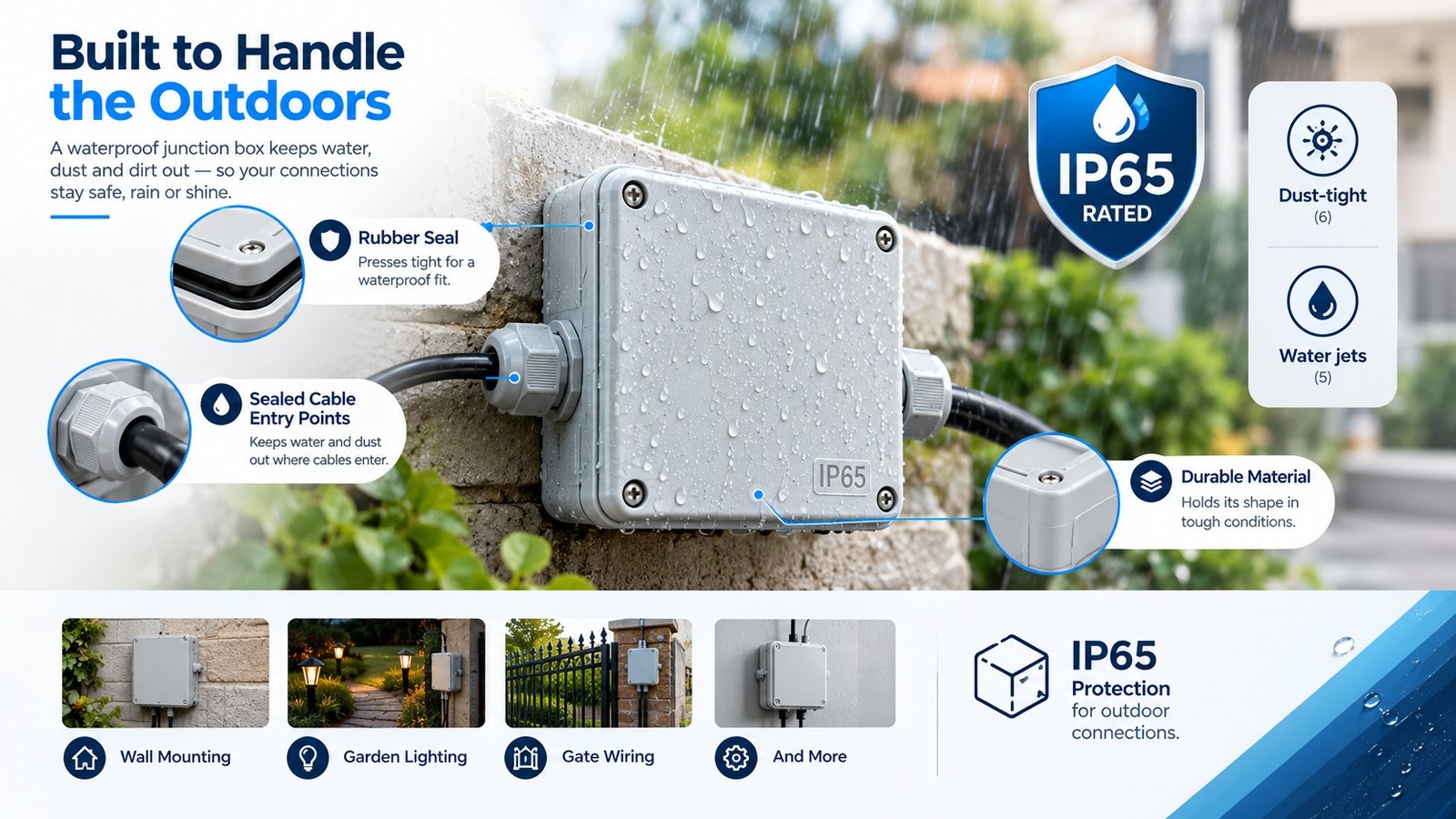
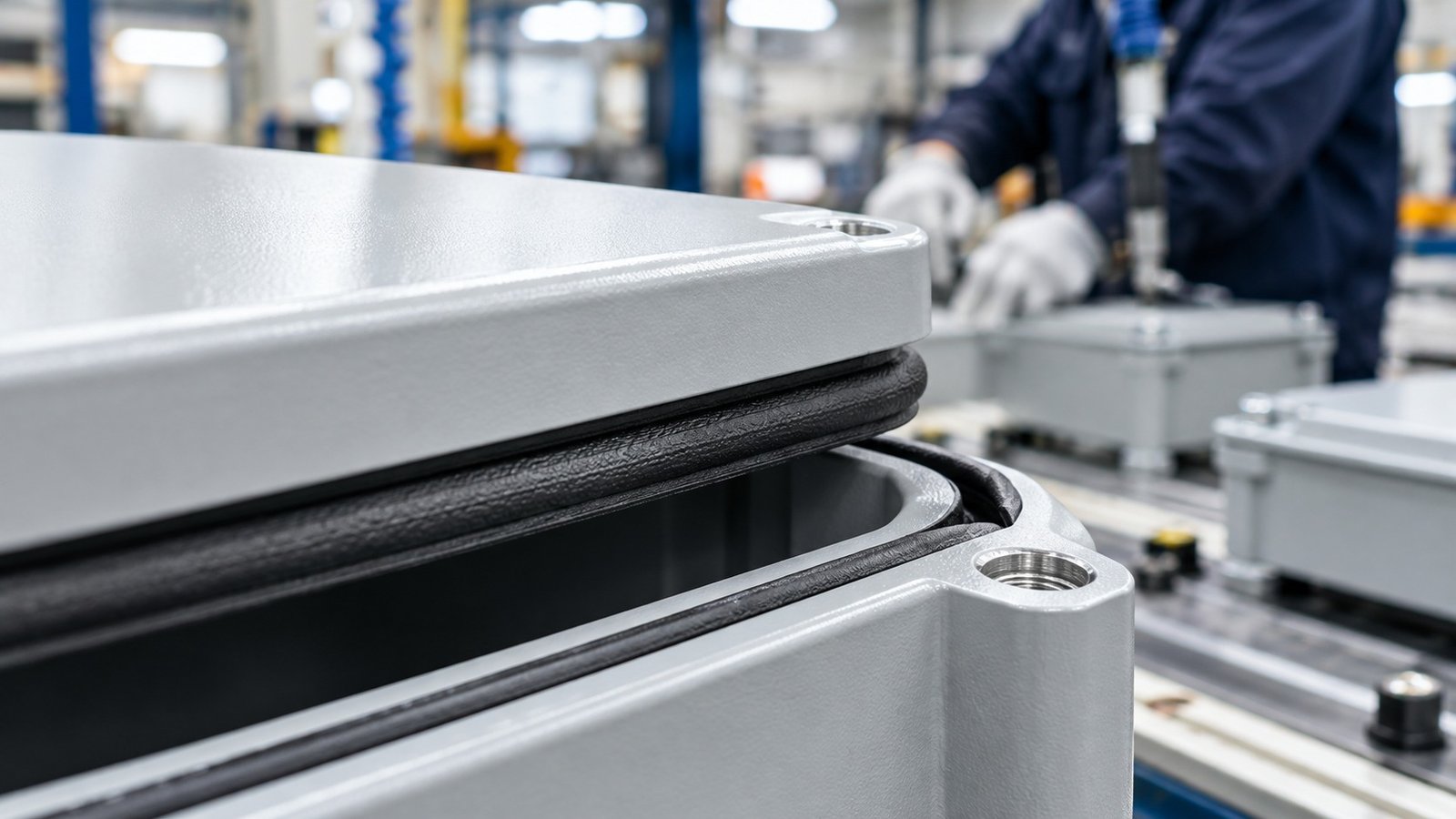
A waterproof junction box has a lid that presses against a rubber seal, a body with sealed cable entry points, and a material that holds its shape outdoors. The seal sits in a groove around the lid or the base, and when the screws are tightened, the rubber is squeezed just enough to fill the tiny gaps between the two parts.
Most outdoor boxes carry an ingress protection (IP) rating, which is a two-digit code that describes how well the enclosure resists solids and water. The first digit covers dust and the second covers water, so an IP65 junction box is dust-tight and can handle water jets from any direction, such as heavy rain or a garden hose.
An adaptable outdoor enclosure junction box with an IP65 rating suits wall mounting, garden lighting, gate wiring, and similar jobs. The rating comes from a lab test on a new box with the correct fittings, so it describes the box as built and doesn’t cover a loose lid, a cable hole drilled in the wrong place, or a seal that has aged for five years.
How the Rubber Seal of the Junction Box Works
The rubber seal is the main barrier between the weather and your wiring. It works by staying slightly squeezed around the lid, but only as long as it can spring back to its original shape.
Rubber that stays squashed for a long time slowly loses that springiness, which is called a compression set. A flattened seal can still look fine from the outside, but it no longer pushes hard enough against the lid to block water.
Heat speeds this up, so a box in direct summer sun ages faster than one in shade. Sunlight and ozone can also crack some rubber types over time, and materials such as EPDM and silicone are commonly used for outdoor seals because they cope well with weather.
A seal can also fail from the start if it sits unevenly in its groove, is twisted, or the lid screws are tightened in a rush. An uneven squeeze leaves one corner loose, and wind-driven rain needs only that to get in.
Common Reasons Water Gets Into a Sealed Box
Moisture finds its way into a sealed junction box through a handful of repeat causes. The table below lists the usual ones.
Cause | What Happens |
Unsealed cable entry | Water runs along the cable and slips through a loose or oversized gland |
Uneven lid tightening | One side of the seal is squeezed less, which leaves a gap |
Worn or flattened seal | The rubber has lost its spring and no longer presses firmly |
Holes drilled on top | Rain collects on the box and drains straight into the new opening |
Moist air trapped inside | Water forms on cold surfaces when the box cools overnight |
Cable Entries Are the Weak Spot
A box can be perfectly sealed at the lid and still leak through cable entry holes. Each cable needs a gland or grommet that matches its thickness, because a gland that is too big for the cable leaves a ring-shaped gap. Water follows the cable down its outer jacket, so a cable that rises above the box and then drops into it gives rain a direct path inside.
Temperature Changes Pull Moisture In
An outdoor box heats up in the sun, and the air inside expands. At night, or when cold rain hits the box, that air cools and contracts, creating mild suction. A small pressure change like this repeats daily, and each cycle can pull a little damp air or water past the weakest point in the seal. A US patent document on sealed enclosures outdoors notes that water vapor in the trapped air condenses on internal parts and corrodes electrical contacts, as described in a US patent document on pressure equalization in sealed enclosures.
As a result, a fully sealed box can collect moisture even if the lid has no leaks. On a humid day, trapped damp air can condense as the box cools, which is why wiring done in wet weather can cause trouble weeks later.
Why Material Matters: ABS Plastic and Dustproof Protection
Plastic junction boxes are popular because they don’t rust, are lightweight, and are easy to drill and mount. An ABS plastic dust-proof junction box is a common choice for homes and workshops since ABS is tough, holds its shape, and works well with a rubber seal to block dust and splashes.
ABS has one limit worth knowing: sunlight. Standard ABS contains a rubbery component that ultraviolet (UV) rays can slowly break down, so a box in strong direct sun may fade, turn chalky, and become brittle after a few years. A brittle lid can crack at the screw holes, and a cracked lid no longer seals, no matter how good the rubber is. Polycarbonate and UV-stabilized ABS handle sun better, and the product data sheet usually states whether the plastic is rated for outdoor use.
Placement | Practical Advice |
Shaded or covered spot (under eaves, inside a porch, behind a gate) | Standard ABS performs well and keeps dust out |
Open wall in full sun | Choose a UV-rated plastic or add shade with a small cover or roof |
Coastal or very hot areas | Pick a UV-stabilized material and inspect the seal each year |
How to Install a Junction Box So It Stays Dry
Good installation does more for a junction box than the rating printed on the lid. These habits make a clear difference, and each one takes only a few minutes.
- Face entries downward. Cable holes on the bottom or sides let water drain away, while holes on top let it pour in.
- Make a drip loop. Let each cable dip below the entry point before it rises into the box, so rain drips off the lowest point of the curve.
- Match each gland to its cable. The gland should grip the outer jacket firmly, and close any unused hole with the plug that came with the box.
- Seat the seal before closing. Check that the rubber sits flat in its groove with no twists, and clean away grit that could hold the lid open.
- Tighten screws in a crossing pattern. Work from corner to corner in small steps so the pressure spreads evenly around the lid.
- Wire on dry days. Moist air trapped inside the box causes many later droplets.
- Mount the box upright on a flat surface. A flat wall lets the seal press evenly, and an upright position helps water run off the lid.
Small vent plugs or breathable cable glands can also help in places with large day-to-night temperature swings because they let air move in and out slowly while keeping rain and dust out.
A Simple Yearly Check is Worth It
An outdoor junction box benefits from a quick check once a year, and twice a year in harsh weather. On a dry day, open the lid and look for droplets, rust marks, or a white, powdery film on the terminals. Gently press the seal with a finger; if it feels hard, flat, or cracked, replace it. Check the lid and corners for hairline cracks, and make sure each gland still grips its cable. Switch off the power at the supply before opening any junction box with live wiring.
Choose the Right Junction Box for Your Project
The best junction box for outdoor wiring depends on the IP rating, seal quality, cable-entry design, and a material that matches the site’s sun and weather. If you want help matching a waterproof connection box with a rubber seal to your project, send us your requirements and request a quote today.
Frequently Asked Questions
Can water get inside an IP65 junction box?
An IP65 junction box can let water in if the seal is worn, the lid is tightened unevenly, or a cable entry isn’t sealed. The rating applies to a new box fitted correctly, so poor installation can still let moisture in.
Why is there condensation inside my junction box?
Condensation in a junction box forms when warm, moist air cools inside the enclosure and turns into droplets. Day-to-night temperature swings repeat this cycle, and in humid weather, wiring traps moist air in the box from the start.
How long does a rubber seal on a junction box last?
A rubber seal on a junction box lasts several years in most conditions, though heat, sunlight, and repeated opening shorten its life. Replace a seal that feels hard, flat, or cracked, even if the box still looks fine.
Is an ABS junction box suitable for outdoor use?
An ABS junction box suits covered or shaded outdoor spots, since ABS blocks dust and splashes well. But direct sun can make standard ABS brittle over time, so exposed locations need UV-rated plastic or some shade.
Should I add silicone sealant around a waterproof junction box?
A waterproof junction box already relies on its rubber seal, so sealant on the lid is usually unnecessary and can make it harder to open. Use sealant around the wall-mounting edge and at the cable glands, where gaps can appear.